

Bracketing: A Better Way To Understand Value
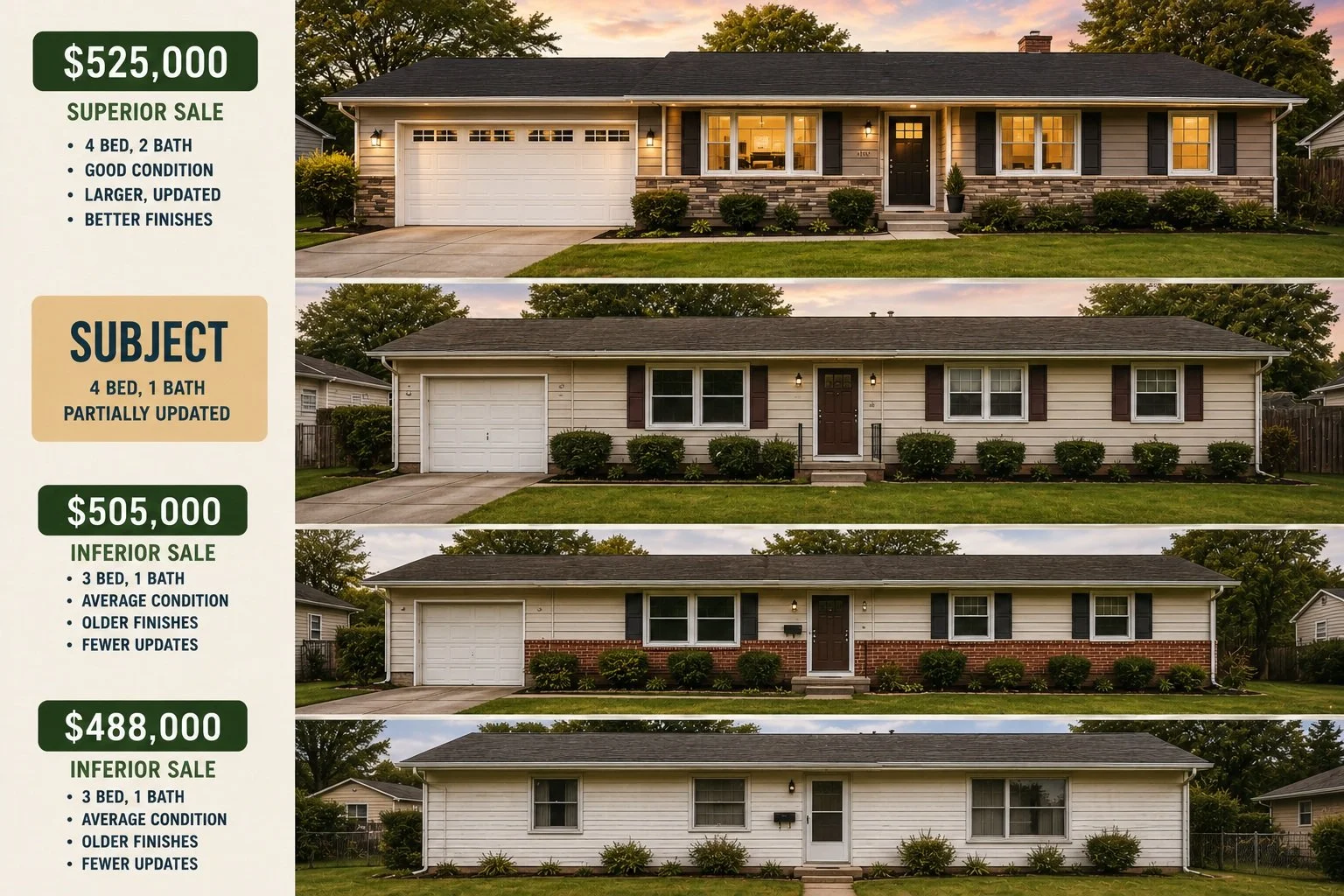
Bracketing: A Better Way to Understand Value
When comparing properties, it is easy to focus too heavily on adjustments. If one property is larger, adjust for size. If another has a better view, adjust for view. But adjustments do not replace good comparable selection. Bracketing often provides a clearer and more credible way to understand where a property fits in the market.
What is bracketing? Bracketing means selecting comparable properties that are both superior and inferior to the subject for an important characteristic. For example, if a subject has 2,500 square feet of living area, the comparable sales might include properties with 2,300, 2,450, 2,650, and 2,800 square feet. The subject falls within the range demonstrated by the market.
The same concept can apply to condition, quality, lot size, garages, views, acreage, location, floor level, or other characteristics that influence buyer behavior.
The sales comparison approach is based on the principle of substitution: a rational buyer generally will not pay more for a property than the cost of acquiring an equally desirable alternative. Bracketing applies that concept directly. Suppose a subject has a particularly good view. A sale with an inferior view may demonstrate what buyers pay for a lesser alternative. A sale with a superior or similar view may demonstrate what buyers pay for the type of property the subject actually competes with. The value conclusion is then supported by the position of the subject within actual market alternatives rather than depending entirely on the mathematical accuracy of one adjustment.
That is the strength of bracketing.
This becomes especially important when a property has an unusual or particularly influential feature.
Consider a high-rise condominium. Units on upper floors may have expansive views, greater privacy, and less exposure to street-level activity. Units on lower floors may offer a substantially different experience to buyers. Even if an appraiser develops a well-supported adjustment for floor level, that does not mean a group of low-floor sales, with adjustments, becomes the best evidence for the value of a high-floor unit with exceptional views. If buyers shopping for a high-floor view unit are primarily comparing it with other high-floor view units, those sales provide important evidence. Lower-floor units may still establish a lower boundary, but they should not define the analysis simply because their differences can be adjusted.
The more unusual or significant a property characteristic becomes, the more important it is to understand where the subject falls within the range of actual market alternatives.
Examples might include:
Exceptional mountain, water, or city views
Significant acreage
An unusually large site
Direct water frontage
A highly unusual architectural design
An accessory dwelling unit
An oversized or specialized garage
A superior location within a condominium project
In these situations, a sale that shares the subject's defining characteristic may provide more meaningful evidence than a physically closer sale that does not. Distance alone does not determine comparability. Neither does similarity in square footage, age, or bedroom count. The best comparable is the property that competes most directly with the subject in the eyes of the market.
Suppose a subject has an exceptional view. A sale with an inferior view may establish a lower indication. A sale with a similar view may show how buyers respond to the subject's defining characteristic. A sale with an even better view may help establish an upper indication. Taken together, those sales place the subject within a market-supported range. This approach does not require every comparable to be nearly identical to the subject. In fact, some degree of superiority and inferiority is useful because it shows where the subject fits.
An inferior property shows what buyers paid for less. A superior property shows what buyers paid for more. Similar properties help show where the subject competes between those boundaries.
For unusual properties in particular, that market context can be more meaningful than attempting to explain the entire difference through a series of individual adjustments.
A good comparable set should show where the subject belongs.
Bracketing makes that visible.